Big Bubba’s (Alix Hotel)
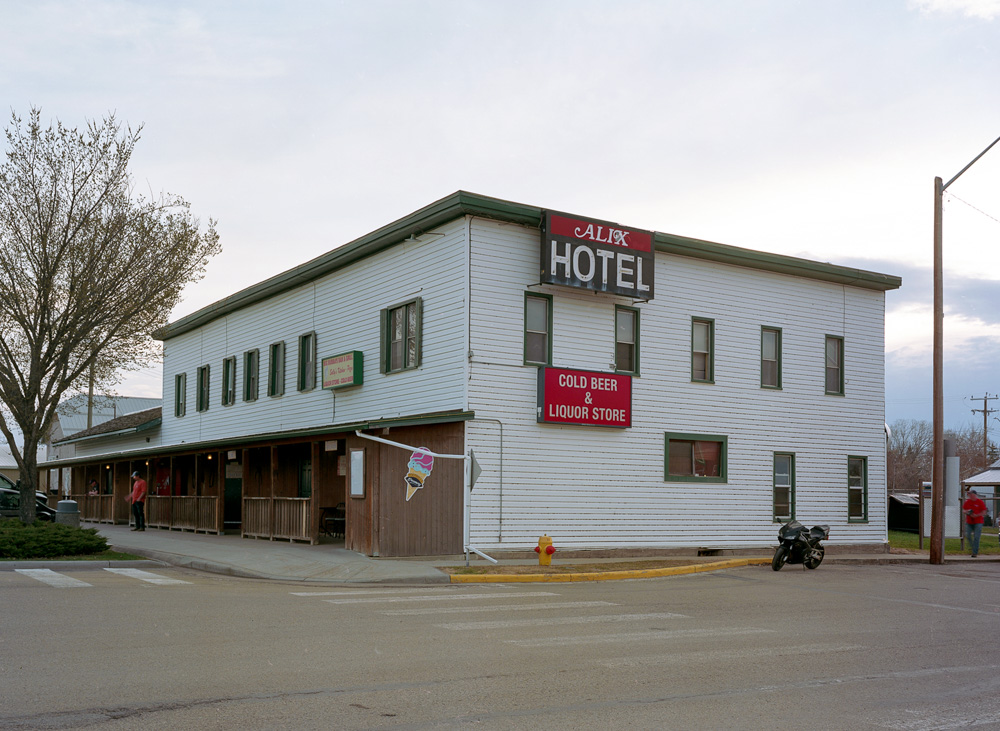
BP 24.0: Big Bubba’s (Alix Hotel) Alix Alberta, built 1904. Visited April 26th, 2025. Team: Rob, Chris & Connie. Camera Gear: Ebony 4×5″ View Camera (Film), Contax 35mm Film, Canon 6D & 70D.
Interviews conducted with: Barb (owner), Roberta (former owner) and Hugh (patron).
Alix Alberta dates to 1904/1905 was founded in anticipation of the coming of the railway. It was called Toddsville briefly, but adopted the current name after a couple years. The tracks came through in late in 1905, and for about six months, this was the end of the line for the Canadian Pacific branch coming in from Lacombe.
This section of railway came off of the main CPR trunk running between the major centers of Calgary and Edmonton. Some years later the track was extended east to Stettler and to points beyond, eventually making its way into Saskatchewan by 1914.
The section from Lacombe to Stettler, running through Alix, remains in use to the present day. It would otherwise be visible from the Alix Hotel, if not for a building obscuring the view. That one is constructed on the site of the former railway station.
“Me and my ex-husband owned it…for 36 years…1972 till 2008. We didn’t plan on having it that long. It just happened.” – Roberta .
“I was so stressed when I first bought it, like you know, trying to do everything perfectly, and now it’s, now you don’t care, it’s like whatever, yeah, just get it done, I forgot to order that again, oh well, yeah, it’s like pick my battles.” – Barb – and it’s how we approach this project too – how ever it happens, it happens.
The prime location for a hotel in virtually every town back then was immediately across from the station, so this placement was deliberate. That is where the action was back then.
The hotel is located on the corner of 50th Street and 50th Avenue. For towns that followed the 50th and 50th street naming convention – and a lot did – this was always the most important intersection.
“I’m Hugh. My wife worked here for 14 years. She’s got plantar fasciitis and diabetes, so she can’t walk much anymore. My daughter is on my pool team right now (pointing at her at the tables). She works here…she’s a cook. I always enjoyed coming here. It’s been one of my favorite hangouts in Alix.” – Hugh – on his connections to the hotel.
“I have hanging baskets in the summer, and I always put them, like, like, 10 feet away from the door, because when they’re angry coming out, they’ll wreck anything, whatever, so you have to put them kind of out of rage distance.” – Barb speaking of the occasional troublesome patron.
Alix seems to have adopted both of the common prairie naming conventions for small towns and this intersection is also known as Railway and Main. It is not clear if one is official use by the town or if either is acceptable.
Those who founded the town had high hopes it would become a busy central hub for the local area and to a degree it is. But it is secondary to the larger towns of Stettler to the east and much larger Red Deer to the west (a city). Both are a relatively short drive away.
Alix became a village in 1907. A second railway came through around 1912, but it skirts the east edge of town. This was originally the Grand Trunk Pacific north/south main, but around 1920 it became a Canadian National track, and is still in use to this day.
“It was about half the size…and we built that in 1976 (an extension to the bar that doubled its size). We only had beer. There was no hard liquor when we started. And, you know, like everybody else, back in 1972, there was no live entertainment. Well, I think when we first bought it no one had ever seen women bartenders.” – Roberta, on the early days.
“I did 32 nights in a row, and did my payroll, and all my other stuff, and whatever, but you just get into a regimen. I’ve learned how to fix satellite TVs, and ATMs, and, you know, because you have to.” – Barb.
The Alix Hotel dates to 1904, and this makes it the oldest Hotel visited by the Beer Parlour Project so far. It’s as old as the town itself!
For the first two decades the Alix was known as the Imperial Hotel and for a time starting in 1920s called the Happy Valley Hotel. At some point after, 1940s suggested, the name was changed to the Alix Hotel and it has stuck ever since. Big Bubba’s Bar is named after the owner’s deceased dog and not some good-ol’-boy character as it might suggest.
In the early days there were other Hotels in the town. During the 1910s and ’20s there was a Grand Hotel in Alix, although the exact location is not known. It was of a similar size to the current Alix Hotel.
“The first week of December, I have a Santa’s Anonymous, that’s a big, big deal, and I raised, like, I did, like, $5,500 once, but before COVID, now, like, $3,500, which is still pretty good for these days, in a small town, right, for Santa’s Anonymous. It goes to the kids around here.” – Barb, on doing what she can to help the community (we see this often from hotel owners, but rarely do they get credit).
“Well, I had a business degree, and my ex-husband had a coal mine…Sisson’s Coal Mine, south of town. So 1972 rolls around, and let’s buy a hotel. And then we hired my brother because he had a little bit of experience, and we just were young and could try anything once, you know?” – Roberta, on taking the plunge.
There was also a Hotel Nelson, located directly across Main Street from the Alix, and it operated into the 1970s. It was smaller than the Alix and the property currently serves as a storage lot.
An interesting tid-bit of history was discovered while we researched the Alix Hotel. The local history book quotes a Mrs. Alice Bearchell, telling of her father Thomas John Curr, owner of the Imperial at the time, and of his losing title to the property in a poker game. It seems Mr Curr had a bit of a gambling problem and also lost other businesses he owned at around the same time.
Reverend Mott, the first Anglican minister in Alix, held church services in his room at the Imperial Hotel until the original St. Pancras Anglican Church was built in 1911. He could have kept busy saving all the patrons downstairs.
“I actually was friends with Roberta that you’ve met, that owned the bar before, and she was always looking for bartenders, so I always wanted to be a bartender. So, I started working one day a week, and then I quit my real job. I worked at the local malt plant (the big grain elevator at the edge of town). I worked here for a year, so I mean, I knew how things worked, but owning it is totally different than working here. So, but here I am, 17 and a half years later.” – Barb, on transitioning into the business.
Over the past 120 years the Alix/Imperial/Happy Valley Hotel has had at least 15 owners, and probably more. Some operated the business for an extended period of time, while others only lasted a year or two. It is obvious there were many challenges to being in this business back in the day, just as there are today.
It is not known what happened at the Alix during prohibition, but it can be assumed the hotel continued to operate, just without the beer parlour. Those must have been dark days for both hotel owners and their loyal beer drinking clients.
The Alix Hotel is little changed over the years. The overhang out front is relatively new, and in the 1970s, an extension to the Beer Parlour was added on the southwest end, but otherwise it looks much like its old self.
“And then I brought in live entertainment, and of course, that was huge. And then we built on because people were dancing on the tables…” – Roberta.
“It’s such a love-hate business. Some days it’s so fun, and other days, oh my God!” – Barb, more on the ups and downs of owning an old hotel.
The Hotel has housed a diner, café or coffee shop since the early days and it is still there today. Currently it is known as Sally’s Kitchen. Sally was a dog owned by current operator Barb, as was, Big Bubba mentioned earlier.
Many of the hotels visited by the team once had eateries like Sally’s, but many are closed down. Alix seems to be bucking that trend. There is also a liquor store here, and it seemed busy on the day of our visit. Rooms were available up until the 1990s, but like many old hotels of this type, they are now rented out long term. As apartments.
We could not locate population data for Alix prior to 1920. The town has seen a slow and steady growth from under 300, up until the Great Depression, and increasing to about 350 by the war years. From the 1950s until its peak in the 1980s the population gradually increased to about 850. Today the numbers are down slightly.
“But I did love the business…no regrets…none.” – Roberta.
“COVID was a big trial. You were down for a few months, and then, yeah, then it slowed down afterwards because no one wanted to go out and recreate it. Especially in my café, because I had it closed for two years. They were so used to not coming out and doing takeout, so people didn’t come. I didn’t bother opening it for two years. By this time, it’s just changed the the whole culture…it changed the dynamic, absolutely. And the younger generation, everything’s on demand and they’re just not into the bar scene at all. Where we couldn’t wait, oh yeah, to be 18 and go in a bar.” – Barb, on the difficulties of the last few years.
Agriculture and natural resources are the main jobs in the area. There is a large malting plant at the edge of town that employees a number of locals (including once, the current owner of the Alix Hotel) and the complex dominates the skyline to the east. There are a small number of stores and businesses in downtown, as well as a few more along the highway.
Alix is doing a lot better than many of the communities we have visited.
The town is named for Alexia (or Alice) Westhead, an early pioneer and rancher who was known as Alix. The town mascot is an alligator caricature named Alix-Gator.
Alix, Alberta: Population about 800 and it is located in Lacombe County about 55km northeast of Red Deer and 38km west of Stettler.
“Well I ain’t seen my baby since I don’t know when
I been drinking bourbon whiskey, scotch and gin
Gonna get high man, I’m gonna get loose
Need me a triple shot o’ that juice
Gonna get drunk, don’t you have no fear
I want one bourbon, one scotch and one beer”
George Thorogood & The Destroyers

Click image to open lightbox.
35mm = Contax 35mm Film
4×5″ = Ebony 4×5″ View Camera
Film images may reflect the unique challenges & difficulties of shooting in these low light environments.





Know more (new tab): Big Bubba’s (Alix Hotel) Alix Alberta